July 2026 Highlights and Hot Topics

In the July issue of Highlights & Hot Topics, read a message from NCCDD’s executive director, celebrate Wake County's proclamation recognizing the 36th anniversary of the Americans with Disabilities Act (ADA), and catch up on the latest public policy updates. You'll also find NCCDD projects featured in the news, register for upcoming August webinars, and access the newsletter in Spanish or as an accessible audio version.
- Letter from the Executive Director
- NCCDD Receives ADA 36th Anniversary Proclamation from Wake County
- Public Policy Updates (as of 7/23/26)
- NCCDD Project Featured in the News
- Upcoming NCCDD Webinars in August
- Boletín en español
- Newsletter in Accessible Audio
Letter from the Executive Director

Your advocacy made a difference! Thank you. The General Assembly funded over 21 million dollars to increase Direct Support Professional (DSP) rates and over 70 million dollars for Personal Care Services, which means increased rates for CAP-DA and CAP-C. When the federal match is added, the increase in funding is over 200 million dollars.
Please make sure to thank legislators! Also, thank your fellow advocates.
There is no question that our advocacy with the I/DD Legislative Caucus and Health Appropriations Chairs year after year helped make this happen. There is no question that each time you shared your story, you made this happen.
There is an important question, though. Will 1915(i) DSP rates go up with the increase in the Innovations Waiver rates? When the state started 1915(i), it told the Centers for Medicare & Medicaid Services (CMS) that it would keep 1915(i) DSP rates and Innovations Waiver rates the same. I am hoping that we will be able to maintain those rates, but right now we are asking that question even though it is our expectation.
There are other important questions. How much do we need to raise DSP rates to in order to have a sufficient workforce for our aging and disabled population? How much do we need to budget for future DSP wages to maintain that workforce as our population grows? These are critical questions the state is trying to answer with a new Direct Care Workforce Rate Study. Please make sure to participate in this rate study when asked to help with it.
I am reminded of the number of times I wasn’t successful when I planted grass seed. Spring after spring in Atlanta and North Carolina, I would plant grass seed. I would water it and fertilize it, and I was not successful. Then, one autumn, I finally decided to try to grow grass. We now have a flourishing grass lawn in our shaded front yard. It took the right timing and a lot of work.
This summer, we saw some fruit from all the labor we put into our I/DD advocacy. It is just the beginning. We have so much more work to do, but we have made progress. We have significant challenges, including a grave threat to Olmstead and substantial budgetary challenges to Medicaid, but we have each other and our advocacy. We will continue to make a difference.
Talley Wells, NCCDD Executive Director
NCCDD Receives ADA 36th Anniversary Proclamation from Wake County
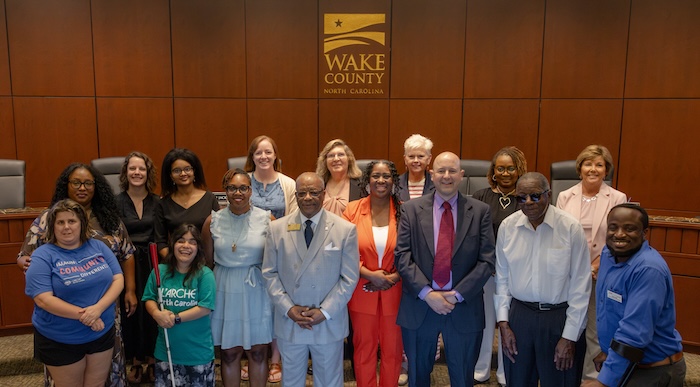
On Monday, July 6th, NCCDD Systems Change Manager Philip Woodward attended the Wake County Board of Commissioners meeting to receive an ADA 36th anniversary proclamation from Commissioner Tara Waters. He also gave remarks to the board to thank them. NCCDD Council Member Tony Hall and community partner Laura Steed also attended the meeting to receive the proclamation.
In his remarks, Woodward said, “I have been involved in many opportunities to issue an Americans with Disabilities Act (ADA) proclamation from the State of North Carolina and the City of Raleigh. It delights me to be here to receive an ADA proclamation from Wake County and its Board of Commissioners. I myself have lived with a disability for 43 years – I was diagnosed with a severe to profound bilateral hearing loss at age four. The ADA has made life immensely better for me, and I started seeing the benefits not long after it was passed in 1990. The Centers for Disease Control and Prevention (CDC) estimates that approximately 32 percent of North Carolina residents have a disability of some type – physical, mental, sensory, intellectual, developmental, or some other type. That is about one-third of the population. Disability is a natural part of human life, and recognizing and celebrating the ADA will help people of all abilities prosper and participate fully in living, working in, playing in, and visiting Wake County.”
Public Policy Update (as of July 23, 2026)
FEDERAL
Budget
The federal budget process stalled after the House passed only three appropriations bills out of the 12 that came out of committees. And on the Senate side, there was no progress on the budget due to no agreement on the total budget number. However, there has been other activity around funding.
Stopgap Measure
The week of July 20, 2026, the House passed a stopgap measure that would fund federal agencies at existing levels through December 4, 2026, in an effort to avert a potential government shutdown before the end of the fiscal year on September 30, 2026. The measure now heads to the Senate, where it faces long odds amid the chamber’s 60-vote threshold and potential Democratic opposition.
Emergency Supplemental Request
President Trump’s administration has requested a 87.6 billion emergency supplemental funding package to fund U.S. military operations against Iran, assist farmers, and respond to the Ebola outbreak. About $67.1 billion of the funding would be provided to the Department of Defense to refill military stockpiles; the remaining $20.5 billion would provide additional support for the U.S. Coast Guard, temporary economic assistance to farmers, international affairs and humanitarian assistance, the design and construction of a modernized Penn Station, and continued restoration projects on the National Mall. The Senate Appropriations Committee held a hearing to review the package July 21, 2026.
Reconciliation 3.0
The reconciliation process is what was used to pass HR1 (OBBB), which included significant Medicaid cuts. Reconciliation is a special legislative tool that can be used by the Senate for mandatory spending and only requires 51 votes instead of 60.
House Republicans on Wednesday approved a $95 billion framework for a third budget reconciliation package that would boost funding for the Pentagon, provide agriculture aid, and provide money to encourage states to adopt voting restrictions.
House Republicans managed to overcome internal disagreements and approve a budget framework for another reconciliation package ($95 billion) on July 22, 2026. This third budget reconciliation package would boost funding for the Pentagon, provide agriculture aid, and provide money to encourage states to adopt voting restrictions.
This is only the first vote in a long, multistep budget reconciliation process, which requires that both the House and the Senate adopt the same budget framework. So now the process moves to the Senate, where it is uncertain whether there is enough support for a reconciliation budget.
Federal Administration - Medicaid work requirements
Last month, we covered the Centers for Medicare and Medicaid Services (CMS) interim final rule around the process for determining and proving someone is “medically frail” for exemption from new work requirements. It creates a more restrictive definition of “medically frail.” This new rule creates additional administrative burdens for the person and for the Medicaid program, and more people will lose access to healthcare.
A coalition of officials from 25 states and Washington, D.C., including North Carolina, filed a lawsuit challenging recently released rules for Medicaid work requirements. In the lawsuit filed against CMS and the U.S. Department of Health and Human Services, the states allege that the Trump administration’s interim final rule is more restrictive than Congress intended. The complaint also names CMS Administrator Mehmet Oz and Health and Human Services Secretary Robert F. Kennedy Jr.
All House Democrats sent a unified letter to CMS demanding that the administration reverse course on this rigid new rule.
While the rules apply to the Medicaid expansion population, the I/DD community should be concerned and provide feedback:
- Some people with I/DD may be in the expansion population and directly impacted.
- Additional administrative and paperwork burdens on the Medicaid system can affect everyone on Medicaid.
- It is an opportunity to point out that these rules go against the administration’s promise to protect all vulnerable populations. It is not being followed.
Department of Justice and Olmstead
In 1999, the Supreme Court in Olmstead vs LC recognized that people with disabilities have a ‘right to live in the world’ and states have an obligation to provide services in the community that promote integration. This ruling is the foundation of disability rights and so integral to the inclusion of people with I/DD in their communities.
In the June Highlights & Hot Topics newsletter, we covered an opinion that was issued in June by the Department of Justice saying that federal law does not explicitly require states to provide community-based care for people with disabilities. The memo asserts that neither Title II of the Americans with Disabilities Act nor Section 504 of the Rehabilitation Act contains a strict "integration mandate" that forces states to serve people in community-based settings instead of institutions. This interpretation goes against current federal integration policy and signals a shift in enforcement regarding the Olmstead mandate.
Following this, on July 20, 2026. the U.S. Department of Justice issued a notice clarifying that its long-standing guidance on enforcement of the ADA’s integration mandate and Olmstead v. L.C. is “not enforceable.” In other words, the Department of Justice will not rely on the guidance from Olmstead to enforce Title II of the ADA. This creates further uncertainty and anxiety among advocates and people with disabilities.
While neither the opinion issued in June nor the notice issued in July carries the full force of law – neither takes away the Olmstead ruling or the ADA or Section 504 – there is a real fear that the rights of people with disabilities to live in their own homes and communities are being threatened. The guidance from Olmstead has been one of the strongest protections for people to remain in their communities and not be forced into institutional care. It is alarming that the federal government may not enforce these laws.
Department of Education
Last month, we covered some of the changes occurring within the Department of Education. Oversight of special education programs, transition services, and vocational rehabilitation is moving to the U.S. Department of Health and Human Services. Responsibility for investigating disability-related education civil rights complaints will move to the U.S. Department of Justice. Considering the Department of Justice’s recent interpretation of Olmstead, the protection of students with disabilities to receive Free and Appropriate Public Education (FAPE) under the Individuals with Disabilities Education Act (IDEA) is also a growing concern. Dividing the support and oversight of these educational services among other federal departments will create an environment where it is harder to know how to get help when a student’s needs are not being met.
STATE
Budget
We finally have a budget in North Carolina! The legislature passed the $34.4 billion state budget on July 2, 2026, and it was signed by the Governor on July 7, 2026. Key investments included in the budget are raises for teachers, state workers, and law enforcement officers, as well as $700 million for ongoing Hurricane Helene rebuilding and relief efforts.
Investments that impact people with I/DD include:
- Fully fund the Medicaid rebase.
- Restart the Healthy Opportunities Pilot, an innovative Medicaid initiative that addresses food insecurity, housing, transportation and other non-medical factors that influence health.
- Fund the state's share of SNAP administration, helping maintain North Carolina's SNAP program, but shifting new administrative costs to counties.
- Increase pay for direct support professionals (DSPs) - $21.3 million.
- Increase rates for personal care services - $70.8 million.
- Recipients of Innovations waiver and Traumatic Brain Injury waiver services will have no copays.
- Provide additional funds for I/DD work training programs at community colleges.
While the budget does not include funding for additional Innovations waiver slots, I/DD advocates were surprised and pleased to see the increases in pay for DSPs. The advocacy and education about the needs for DSPs has been effective!
IOLTA Funds
The Interest on Lawyers’ Trust Accounts (IOLTA) program has historically provided grants to more than 40 organizations across the state, including Disability Rights NC and Legal Aid of NC, in their work to secure and protect basic needs around housing, health care, and employment. The budget includes a provision that redirects IOLTA funds away from civil legal aid and moves funds toward criminal defense services. The funds for civil legal aid will drop dramatically from $12 million to less than $2 million per fiscal year. North Carolina is the only state in the country to make this shift. This is another area where supports to protect the rights of people with I/DD seem to be eroding.
Lawmakers are scheduled to return to Raleigh on July 27, 2026.
NCCDD Project Featured in the News
The North Carolina Council on Developmental Disabilities’ Autism and I/DD Safety Training for First Responders initiative was recently featured by Spectrum News. The story highlights how the training is helping law enforcement better understand and safely interact with people with autism and other intellectual and developmental disabilities. The project is expanding across North Carolina to improve communication, build trust, and create safer outcomes for everyone.
Read the Spectrum article here: https://spectrumlocalnews.com/nc/charlotte/news/2026/06/08/raleigh-first-responders-autism-training
Upcoming NCCDD Webinars in August
The North Carolina Council on Developmental Disabilities (NCCDD) offers several monthly webinars to help you stay educated and informed. All meetings are free and open to the public. Stay informed and become involved in important conversations – there’s something for everyone in the I/DD community!
Policy Education Meeting
Thursday, August 13, 2026, from 10:30 AM to Noon
Learn about important updates to state and federal policies, budget developments, and other issues that affect people with intellectual and developmental disabilities (I/DD). There will also be time for questions and open discussion. Please note that NCCDD only provides public policy education. The Council does not lobby on specific legislation.
Register here: https://www.zoomgov.com/meeting/register/vJItdu-uqD8oHpxzFX9FiES_lSmk_8OP4r4#/registration
Self-Advocate Discussion Series
Topic: Assistive Technology
Wednesday, August 19, 2026, from 1 - 2 PM
The North Carolina Assistive Technology Program (NCATP) has experienced important changes during the last year. Join us to learn more! The NCATP is a state and federally funded program that provides assistive technology services to people of all ages and abilities in North Carolina. NCATP leads North Carolina's efforts to carry out the federal Assistive Technology Act of 2004 by providing device demonstrations, short-term device loans, and reutilization of assistive technology. NCATP promotes independence for people with disabilities through access to technology.
Note: Please register at least one week before the session.
To register: https://www.zoomgov.com/meeting/register/GwJ-kZReQ7G4Joz9GYr_6g#/registration
Learn more about his webinar series: https://nccdd.org/get-involved/self-advocate-discussion-series
The Council Presents
Topic: Olmstead 101
Thursday, August 27, 2026, from 1 - 2 PM
This session will be a panel discussion including the history of the Olmstead Decision, national Olmstead policy achievements, an overview and implementation update of the North Carolina Olmstead Plan, and an opportunity for self-advocates and panelists to talk about how the Olmstead Decision has impacted the lives of people in North Carolina and across the country. You will hear from state experts, including Bryan Dooley, self-advocate; Deb Goda, former Director of NC DHHS Olmstead Section; Kelly Crosbie, Assistant Secretary of the DMH/DD/SUS; Corye Dunne, Director of Policy of Disability Rights North Carolina; and C. Talley Wells, Executive Director for NCCDD and former Georgia “Olmstead Case Lawyer.”
To register: https://www.zoomgov.com/meeting/register/JTEBPG47SW2g2Z9fVyH0PQ#/registration
Learn more about this webinar series: https://nccdd.org/get-involved/nc-council-presents
Boletín en español
Lea el boletín aquí: Aspectos destacados & temas de interés de julio de 2026
Newsletter in Accessible Audio
Listen to the audio version: https://www.buzzsprout.com/2526321/episodes/19558206